Draft of a chapter I cut from my book Speak Not: Empire, identity and the politics of language, choosing instead to start the story of Welsh with the Brad y Llyfrau Gleision (Treachery of the Blue Books) in 1847.
The Red Flag
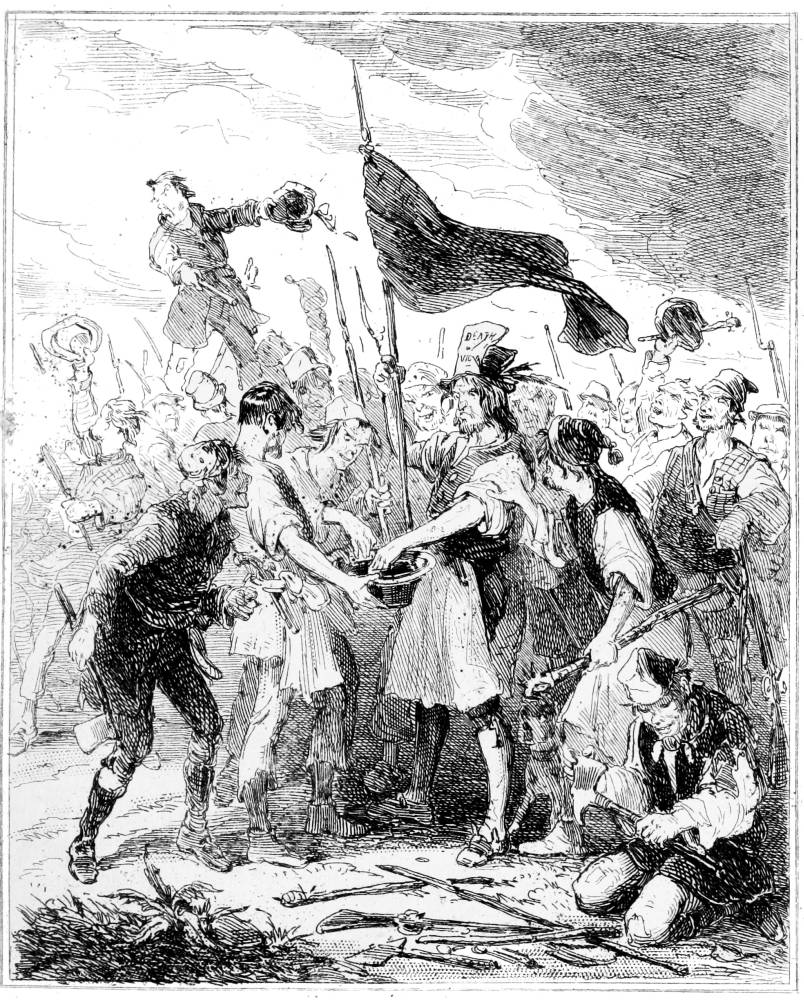
They washed their flags in calf’s blood. The liquid dripped onto the floor, the scent animal and metallic, as the material was dyed a deep, dark red, obscuring the slogans writ upon it. Half-dry, the banners were raised above the crowd, the standard bearers’ hands and arms soon stained pink with gore as the men and women marched through the streets of Merthyr Tydfil, chanting in Welsh, “Reform!”1
It was June 1831. Merthyr Tydfil was one of the chief towns of the United Kingdom, driving both the industrial revolution and the expansion of the British Empire with iron and coal from the Welsh valleys. Situated south of the Bannau Brycheiniog, the sandstone mountain range which divides the large urban centres of South Wales from the sparsely-populated “green desert” of the Welsh midlands,2 Merthyr straddles the Taff river, as its tributaries emerge from the mountains and combine before heading towards Cardiff and the sea. It sat near what was then the English border, and the forefront of Anglicisation. Neighbouring Monmouthshire, though historically Welsh, was already majority English-speaking. For now, however, Merthyr remained mostly Welsh,3 the English a minority of mostly wealthy landlords and businessmen, with a smattering of middle class shopkeepers and tradespeople.4 This linguistic separation served to highlight the already yawning class divide, which by 1831 was reaching breaking point, not just in Merthyr but across Wales and the rest of the UK. Overseas, Britain was settling into an imperial century, that would soon see half of the world map shaded pink, but at home, the wealthiest nation on earth was on the verge of revolution.
Political agitation had been growing throughout Britain in 1831 in support of the Reform Bill, a modest attempt to shape the country’s democracy into something more worthy of that name. Trade union activity was also on the rise, despite severe limitations put on collective bargaining in the wake of the worker-led French Revolution,5 and many demanded an extension of voting rights to the unpropertied classes. (A goal that would not be achieved until almost a century later.) The men and women who took part in the Merthyr rising were also driven by more immediate injustices. A severe economic depression which began in the late 1820s had sent the price of iron plunging, devastating the town’s primary business. 6 Ironwork masters responded by slashing wages and laying off workers, a potentially ruinous development for most families, who could only count for relief on the severely limited provisions of the Poor Laws, the Elizabethan-era welfare state. By the time the crisis reached breaking point in 1831, many working families were heavily in debt to local shopkeepers or their employers. Repayment of loans was enforced the by Court of Requests, a much loathed institution which handled small claims and was staffed by and sympathetic to those making, rather than receiving, the loans. The uprising also had a linguistic and cultural element, with a mostly English, foreign elite on one side, and an almost entirely Welsh working class on the other. The Welsh language would later be used as an explanation by the authorities in London for the unrest in Wales, a barbaric tongue that fostered divisions and prevented people from accepting the glories of the new industrial world.
Even for those not dependent on poor relief or ruinous loans, the situation in Merthyr was grim. Houses had sprung up like weeds as the town underwent a population explosion during the industrial revolution, and many were poorly built and in disrepair. The masters built extravagant manors and mock castles, as the poorest lived in shanty towns and slums, or sought shelter under bridges. Most houses did not have adequate water supply or proper drainage, and the diseases of poverty were rife, particularly cholera, whose victims died in droves, bent over by diarrhoea, their skin turned blue-grey from extreme dehydration. Children were particularly susceptible: between 1813 and 1830, around fifty percent of all children under five died, and as many as 250 in a thousand infants did not make it to their first birthday.7
Paintings of Merthyr at the time depicted the town as a hellish pandemonium of smoke and fire, a description confirmed by Richard Rowe in his 1862 book, How Our Working People Live. Entering the town, a visitor
hears a sighing roar like that of ocean, a hiss of steam, a clank of iron, a whir of wheels; sulfurous smoke and a spray of grit choke his nostrils; he sees round keeps and angular bastions, with fire leaping from their summit and glowing at their base; a forest of chimney-stalks; a jumble of mysterious buildings, of all shapes and sizes; a maze of muddy rails, mounds of coal and lime, piles of metal, timber, and white brick; an army of men, women, and children, whose diverse garments are turned into a uniform by their unvarying grime-facings. The slush on the ground is black as ink and sticky as tar, and men and girls are shovelling it up by truck-loads.8
Many in Merthyr looked to the Reform Bill to bring them relief, and on May 30, a crowd met atop the Waun, a hill overlooking the town, where they debated the issue for hours. Speakers denounced the Corn Laws — which blocked the import of cheap food from overseas — and the Court of Requests, as well as the corruption and callousness of local authorities. In a letter to the Home Secretary, William Lamb, a Merthyr official, said the “magistrates are uneasy” and warned the public were marching in their “hundreds.” That the mood in the town was turning was self evident to all but the most obtuse of its elite inhabitants, but few would have predicted what was to come.
It was cold and dry when the bailiffs arrived in Penderyn on 31 May 1831.9 The one road village of blocky, grey stone houses and a small chapel sat in the Cynon Valley, some 15 kilometres from Merthyr proper. Many in the village had moved to the town, and most of the remaining worked in the iron or coal industries. Lewis Lewis was a rare exception. The son of a butcher and horse trader, he made his living cobbling together a number of jobs, including, occasionally, that of huntsman, for which he earned the Welsh sobriquet “Heliwr.” Lewis the Huntsman had lived his whole life in Penderyn, and there was little to suggest that, aged thirty seven, he was about to make history.
Lewis was not the first man of Penderyn to be visited by the bailiffs. The Court of Requests was becoming a loathed symbol of the hardship and increasing oppression that most working people were living under, a symbol of the cold, impassive state that was doing and would do little to help them in their time of need.10 On that day in May however, the bailiffs had chosen the wrong house. Arriving in the village, they found not a meek and humiliated debtor, but an angry crowd ready to resist them. The crowd refused to allow them to seize Lewis’s property. Eventually a local magistrate was called and got Lewis to agree to a repayment plan, while his creditor, a local shopkeeper, took as collateral the huntsman’s trunk. 11 While he agreed to the deal in the presence of the magistrate and special constables, the loss of a treasured item — trunks or chests were once the most important piece of furniture in a home and remained so in rural areas well into the 19th century12 — did not sit well with Lewis. The following day, he and a crowd of supporters gathered outside the shop in Hirwaun, another village in the Cynon Valley, and demanded its return. The rising had begun.
Lewis’s trunk was the first item returned to its owner by force, but not the last. The crowd set out from Hirwaun to Merthyr, going from house to house inquiring about what goods had been seized by the bailiffs, and then set about returning them.13 Panicked magistrates set themselves up in the Castle Inn and began sending for reinforcements, as the crowd continued to march on Merthyr. Lewis and his men reached the house of Joseph Coffin, president of the loathed Court of Requests, soon after the sun went down. As a contemporary newspaper report recounted, “About eight o’clock last night, the mob attacked Mr. Coffin’s house (the Court of Requests), and, after demanding the books, they commenced their depredations, broke the windows, and destroyed every article in the house, except in one room, and attempted to set it on fire — but the wind being in an unfavourable direction, they failed to do so.”14
At 10am the following morning, after a night in which the increasingly drunken mob attacked more shops and the town’s elite sheltered inside the Castle Inn, the men of the 93rd Sutherland Highlanders Regiment arrived in the town, dressed in kilts and red jackets with yellow facings.1516 On their shoulders they carried flintlock muskets, their barrels tipped with half-metre-long bayonets. They were veterans of the Napoleonic Wars and the War of 1812, but there was to be little glory in Merthyr. It was oppressively hot and threatening storms as the Highlanders arrived in the town and formed up outside the Castle Inn, facing a crowd far larger than their number, many of whom were carrying clubs, iron bars and other makeshift weapons. Over the crowd’s heads waved red flags, their former slogans of reform blotted out by the blood used to dye them. Lewis Lewis stood near the front along with other leaders of the protests, and some who were not leaders but would be singled out for punishment later, including a twenty three year old miner known to his friends as Dic Penderyn.
Emboldened by the presence of the soldiers, the magistrates read the crowd the Riot Act and demanded they leave, the commands given in English and then translated into Welsh, at which points the crowd roared in defiance and raised their makeshift weapons.17 They surged forward, scuffling with the Highlanders and the special constables. Lewis and others addressed the mass of people behind them, telling them not to fear the soldiers bayonets, and their speeches were met by more chants in Welsh of “Reform!”
Finally the magistrates agreed to hear their demands, and requested they nominate representatives, who were invited inside the Castle to negotiate.18 By the time the delegation returned outside empty handed, the hour allotted by the Riot Act was up, and the crowd were again ordered to disperse, this time “on pain of death.” Instead the crowd began shouting for the iron masters to face them, before breaking into a chant of “caws gyda bara,” bread and cheese, bread and cheese!19 Men cannot live on bread alone, and the men and women of Merthyr had little of that to begin with.
Few of the Highlanders, battle-hardened as they might have been, had faced a riot before. They were used to encountering the enemy on an open battlefield, having time to prepare for the charge and thin their numbers with disciplined musket fire before the close fighting began. Compounding the chaos was the fact the crowd and soldiers spoke different languages and none understood except for a handful of magistrates and special constables what Lewis was shouting, as he called on the crowd to seize the soldiers’ guns and storm the Inn. Even if they had had time to prepare for the charge, the close confines of the streets made the muskets useless: there was no way to level them for a volley or even fire a warning shot. Those soldiers outside the Castle were quickly overwhelmed by the crowd, who beat them with clubs and seized their muskets from them. The fighting quickly spilled over into the Inn itself, where a small number of Highlanders were able to level their bayonets and hold the crowd off. Others ran to the windows overlooking the street. Finally, the soldiers were able to take advantage of their greater arms and training.20 They began firing into the crowd, filling the street below with smoke, blood and the deafening crash of repeated volleys.
The crowd was finally dispersed after “a most lamentable slaughter had been made,” and the magistrates and soldiers were able to retreat. The workers were left in full control of the town, but the end of their brief uprising was already in sight. As more military reinforcements, including cavalry, converged on Merthyr, small groups of armed men patrolled and paraded on hilltops around the town, but their numbers grew smaller and smaller, and within a day or two the revolt was over.
Concerns over further violence may have influenced the relatively restrained punishment of the rioters. Only a handful of men were arrested, including Lewis and Dic Penderyn, who was accused of stabbing a soldier with a bayonet. Despite numerous witnesses attesting to Dic Penderyn’s innocence, both he and Lewis were sentenced to death. The older man’s sentence was later commuted to transportation to Australia after a special constable testified that Lewis had intervened to protect him during the riot. Dic Penderyn was not so lucky. He was hanged in Cardiff on 13 August 1831, and would go on to be regarded as a Welsh working class martyr.21 Lewis and five other men, the youngest just twenty years old,22 were transported to Australia aboard the John on 26 January 1832, along with two hundred other convicts. They landed at the penal colony of Port Macquarie, on the New South Wales Coast, six months later.23
Their punishment did not mark the end of unrest in Wales, which would be plagued by insurrection and violence for years to come. In the late 1830s and into the 1840s, industrial areas of South Wales, particularly around Newport and Merthyr, would be the heartlands of Chartism, the reformist political movement that brought Britain closer to revolution than at any time since the Civil War. Around the same time, agricultural areas of Wales saw their own political unrest in what would become known as the Rebecca Riots.
Just as in Merthyr, the Rebecca Riots were motivated in large part by the divide between the poor — small farmers and agricultural workers — and the predominantly English or English-speaking landowners.24 As historian Geraint Jenkins writes, “the bitter hatred which the Rebecca rioters nursed towards landowning families was partly attributable to the fact that magistrates treated tenant farmers ‘like dogs’.”25 Even The Times, newspaper of record for the landed elite, noted that the magistrates’ behaviour was “oppressive, insulting, haughty and offensive.”
Borrowing from a traditional practice of mob justice known as the Ceffyl Pren26, or wooden horse, in which those accused of infidelity were paraded through town by a mob dressed in women’s clothes with their faces blackened,27 the “daughters of Rebecca,” as they would be known, attacked toll gates across the Welsh countryside in dresses and bonnets. While at first the unrest was isolated to the countryside, by 1843 it had spread to industrial areas. By then, the targets were not just toll gates, but “monoglot English stewards, tithe receivers, builders of weirs, encroachers on the commons, greedy landowners and tenants who leased more than one farm.”28
Both the Rebecca Riots and the Merthyr Uprising, as well as the UK-wide Chartist revolution, had clear political and social goals. But in a bubble of privilege in London, the ruling class was largely unable to fathom that working people could seek to improve their situation, or desired the same type of democracy as provided the rich, and so Britain’s rulers instead pathologised the poor. Nowhere was this easier done than in Wales, where the English elite’s disdain for the working classes combined with existing prejudices towards the Welsh language and traditional culture. The use of Welsh in meetings and at rallies was seen as sinister, and attempt to organise in secret in a language the English masters could not understand. That Welsh was the primary language of the uprisings was not seen as anything to do with demographics, but that the tongue itself must have a disputatious element to it. “If the people had been acquainted with the English language, had had proper instruction provided, instead of being left, as they now are, a prey to designing hypocrites, with religion on their lips and wickedness in their hearts,” a report in The Welshman, read at the time, “they would be at this moment, from the geographical and other peculiar advantages of their position, the happiest as well as the most peaceful and most prosperous population in the world.”29 The solution proposed to the problem of the Welsh language would set it on the course of extinction within a decade, and forever change the culture and character of Wales.
- My account of the Merthyr Rising is based on contemporary press accounts, letters from participants, government reports, and Glyn Williams’ ’The Merthyr Rising’, Croom Helm, 1978. ↩︎
- ‘Welsh History Month: Pumlumon and The Elenydd’, Wales Online https://www.walesonline.co.uk/news/wales-news/welsh-history-month-pumlumon-elenydd-2046978 ↩︎
- ‘Welsh nationality in the mid 19th century’, BBC Wales History https://www.bbc.co.uk/wales/history/sites/themes/society/politics_welsh_nationality.shtml ↩︎
- G. Williams, ‘Dic Penderyn: The Making Of A Welsh Working Class Martyr’, Llafurm, Vol 2 No. 3, Summer 1978, p.110 ↩︎
- G. Williams, ‘The Merthyr Rising’, Croom Helm, 1978, p.75 ↩︎
- G. Williams, ‘The Merthyr Rising’, Croom Helm, 1978, p.89 ↩︎
- G. Williams, ‘The Merthyr Rising’, Croom Helm, 1978, p.50 ↩︎
- R. Rowe, ‘How Our Working People Live’, Strahan And Company Limited, 1862, p.17 ↩︎
- G. Williams, ‘The Merthyr Rising’, Croom Helm, 1978, p.112-113 ↩︎
- G. Williams, ‘The Merthyr Rising’, Croom Helm, 1978, p.91 ↩︎
- G. Williams, ‘The Merthyr Rising’, Croom Helm, 1978, p.115 ↩︎
- O. Fitzgerald, ‘American Furniture: 1650 to the Present’, Rowman & Littlefield, 22 Dec 2017, p.8 ↩︎
- B. Saunders, ‘The Merthyr Rising 1831’, 22 August 2007, LibCom.org https://libcom.org/library/1831-merthyr-tydfil-uprising ↩︎
- ‘Disturbances amongst the iron-manufacturers in South Wales’, The Observer, 6 June 1831 ↩︎
- ‘A List of the Officers of the Army and of the Corps of Royal Marines’, War Office, 1831 ↩︎
- Why exactly the Highlanders were in South Wales at the time is unclear. Their presence is testified to by countless eyewitness reports and contemporary press coverage, but Army records suggest they should have been in the Americas, or at their depot in Scotland. My inability to find an answer to this small mystery was one of the biggest frustrations writing this book. ↩︎
- G. Williams, ‘The Merthyr Rising’, Croom Helm, 1978, p.130 ↩︎
- ‘The Riot in Wales’, The Bristol Mercury, excerpted in The Observer, 12 June 1831 ↩︎
- G. Williams, ‘The Merthyr Rising’, Croom Helm, 1978, p.134 ↩︎
- H. Colburn, ’The United Service Magazine: With which are incorporated the Army and Navy Magazine and Naval and Military Journal, Part 1’, 1835, p.515 ↩︎
- ‘The Merthyr Rising’, South Wales Police Museum https://web.archive.org/web/20130106101709/http://www.southwalespolicemuseum.org.uk/en/content/cms/history_of_the_force/the_merthyr_rising/the_merthyr_rising.aspx ↩︎
- Convicts transported, HO 11/8, 1831-1832, p.255 ↩︎
- Lewis Lewis, Convict Records https://convictrecords.com.au/convicts/lewis/lewis/115663 ↩︎
- J. Davies, ’A History of Wales’, Penguin Books, 2007, p.379 ↩︎
- G. Jenkins, ’The Welsh Language and its Social Domains’, University of Wales Press Cardiff, 2000, p.49 ↩︎
- P. Carradice, ’Some Welsh customs’, BBC https://www.bbc.co.uk/blogs/wales/entries/5d65f917-5961-3e76-b5ac-ec0c8fb3c0b6 ↩︎
- S. Rhys, ’National Trust discovers “Wooden horse” punishment’, Wales Online https://www.walesonline.co.uk/news/wales-news/national-trust-discovers-wooden-horse-2227746 ↩︎
- J. Davies, ’A History of Wales’, Penguin Books, 2007, p.381 ↩︎
- Quoted in W. Williams, ‘A Letter to Lord John Russell on the Report of the Commissioners appointed to inquire into the State of Education in Wales’, James Ridgway, 1848, p.24 ↩︎


Leave a Reply